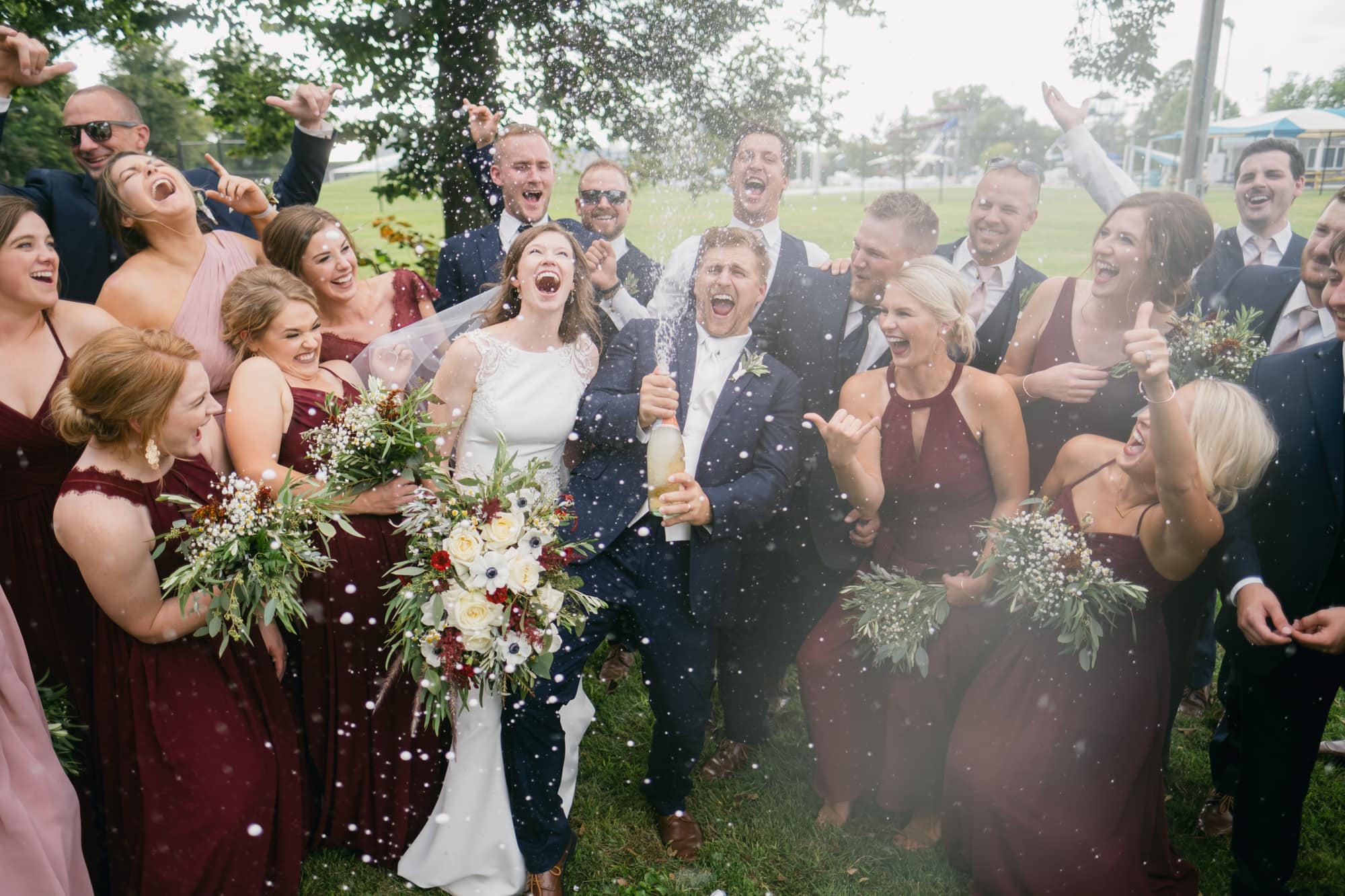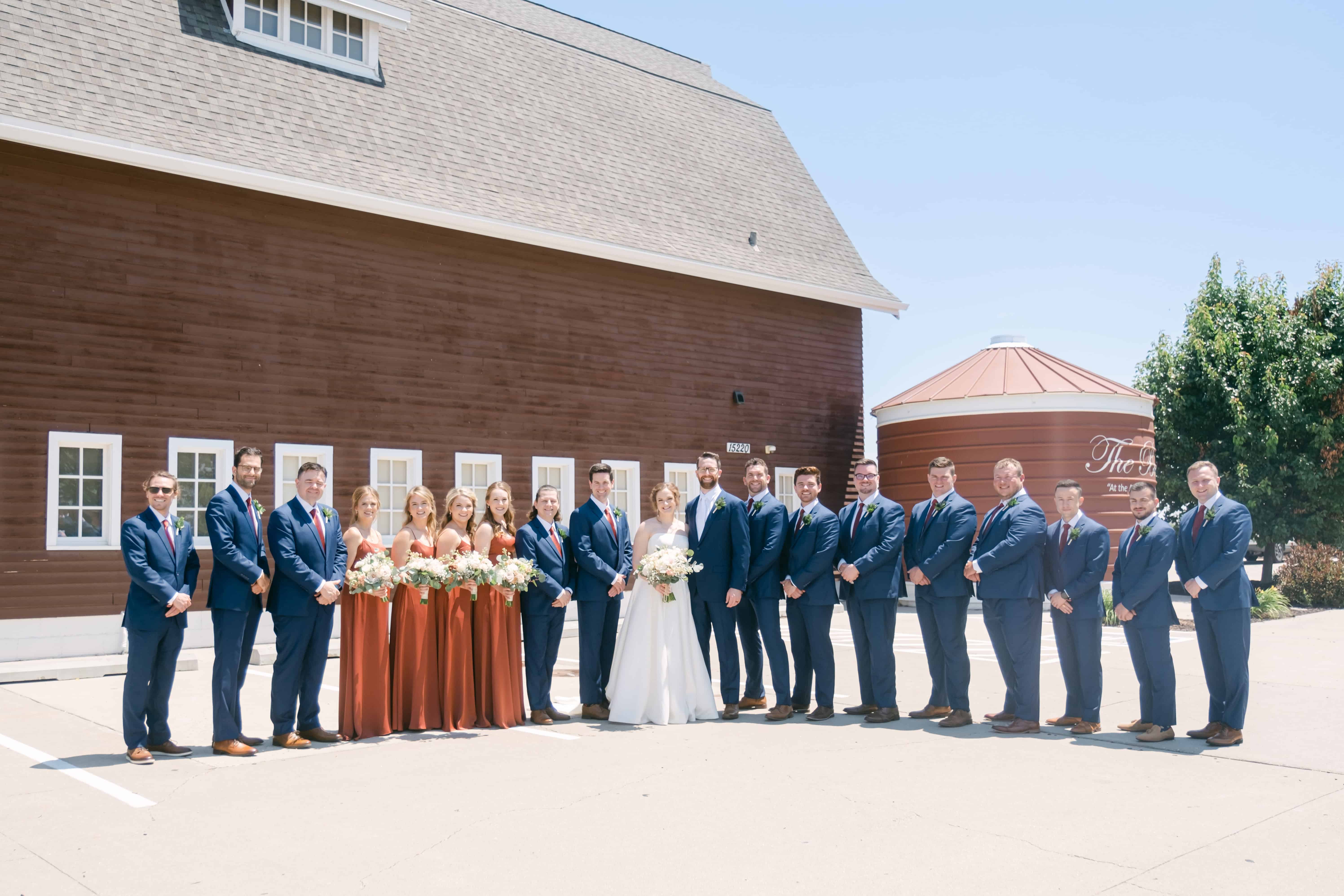
After ten years and a couple hundred weddings, I can tell you a formals list fails in one of two places. It fails on the wedding day, when you're standing in front of forty relatives holding a list that says "Mom" and you don't know who that is. Or it fails weeks earlier at your desk, when you're trying to design photo groupings out of a list of first names.
This guide covers both: the information you need from your couple before the list is even buildable, the ladder that puts the groupings in the right order, how long formals actually take, how to handle divorced parents and step-family without an awkward moment in front of everyone, and the template itself. It's the sibling of my complete timeline guide.
There's a complete family formals shot list further down this page: the full wedding party ladder and the family ladder for each side, ready to copy, adapt, and print.
What is a family formals shot list (and why do you need one)?
A family formals shot list is the ordered list of posed family photos taken on a wedding day, usually right before or after the ceremony. Each entry is one photo: who is in it, by name, in the order the groups will be called. A good list does three jobs. It guarantees coverage: every parent, grandparent, and sibling the couple named lands in at least one photo, and nobody is discovered missing after the wedding. It sets the order: groups are called in a sequence where people step out of frames instead of being re-gathered, so the session keeps moving. And it puts real names in the photographer's hands, so you can call "Kerry and Bob, you're up" to a crowd you've never met instead of asking for "the bride's parents" and hoping the right people step forward.
Every wedding needs one because formals are the one part of the day where you're directing a crowd you've never met, most of whom would rather be at cocktail hour.
I learned the "by name" part at one of the very first weddings I shot. The bride's parents were separated. My questionnaire back then didn't ask for names or relationships in any structured way, so the list in my hand said Mom and Dad. That was it. No names, and no mention of the separation, because I never asked.
At formals I had to quietly ask the maid of honor what the parents' names were. Then I called them both up for a photo together, and the room got a little quieter. Mom and Dad informed me, in front of everybody, that they did not want to be in a photo together. Now it was a relaxed day and we weren't running behind, so I pivoted, split them into individual shots I hadn't planned for, and everyone got their photos. But the mood of that formals session never fully came back, and it was completely avoidable.
That wedding is why the list carries full names and relationships, so I'm calling real names across a room instead of guessing at strangers. And the sensitive part, who shouldn't be grouped with whom, never comes from a form. I ask it out loud, on a call, before every single wedding.
What information do you need before you can build the list?
Before you can build a family formals shot list, you need four things from the couple. Full names, relationships, sides, and extended-family groups.
Full names, because on the wedding day you'll be calling people out of a crowd, and "Kerry and Bob" works where "the bride's parents" doesn't.
Relationships, because groupings are built from them: you can't write "couple with her parents" if you don't know which names are the parents, and last names alone break on marriages and divorce.
The side each person belongs to, so the list can run one family at a time.
And any extended-family group the couple wants photographed, by name, like "the Hendersons," so each one gets its own photo.
Finally, flag anyone who is both family and wedding party, so they land in both sections instead of falling between them. Collected up front, this is everything a complete list needs.
I learned that list of requirements one failure at a time, because my old questionnaire asked for the family list in open text, and couples answered in one of three ways.
Some couples sent titles with no names: "my mom, my brothers, my grandma." That version looks fine on paper but it fails on the wedding day, when you're standing in front of the crowd and you have no idea who "my mom" is. The solution is grabbing a family member to point people out, and it half works, because the person you grab is usually supposed to be in half the photos themselves.
Other couples sent names with no relationships, sometimes just first names. That version fails earlier, at my desk. I'd try to reverse-engineer who was who from last names, which breaks the moment anyone married, divorced, or kept a different name. Usually it meant going back to the couple and asking again, and if you've ever chased a couple to fill out a questionnaire once, you know what asking twice is like. More than once it ended with me on the phone in the final weeks, going through the list person by person, with all the actual list-building still ahead of me.
And then there were the couples who sent names and relationships together. Those lists nearly wrote themselves. With that one answer done right, about 95% of the shot list was built before I ever talked to them again, and the only things left for a conversation were the outliers.
The fix is asking for everything in one pass, and making it hard to answer any other way. The header on the family section of my questionnaire says, verbatim: "PLEASE include full names & relationships of everyone you entered. Please include members of the wedding party who are also family!" The full question set, and the formats that make vague answers almost impossible to give, are in my questionnaire guide.
The ladder method: how do you order the groupings?
Order a family formals shot list like a ladder: start with the largest grouping and remove people one frame at a time, until you're down to the smallest. The wedding party section opens with the entire party in one frame, then steps down through the core party, each side with the couple, one side alone, and individuals. Each family section does the same: the biggest combined family photo first, then immediate family, parents, grandparents, siblings. The ladder pays off twice. Nobody gets re-gathered: once people step out of the frame they're done, free to head to cocktail hour, and nobody who was dismissed has to be found again. And the big opening shot doubles as an attendance check: if everyone is in the first frame, everyone is present for the rest of the list, and a missing person surfaces in the first minute instead of the last.
When I run wedding party photos, the opening frame is the entire group: the couple, all the bridesmaids, all the groomsmen, and if there are ushers, personal attendants, flower girls, or ring bearers, they're in it too. Everybody who is part of the wedding party, in one photo. Partly because it's a photo worth having, but mostly because getting that frame means everyone is standing in front of me, which makes every shot after it faster.
From there it's subtraction. The core party without the extra roles. Each side with the couple. Each side alone. Individuals. By the time I'm shooting the bride with each bridesmaid, most of the group is already done.
Families work the same way, just more situationally, because families come in more shapes than wedding parties do. Big family with lots of siblings and the grandparents present? Big combined shot first, then break it into segments. Small family? The ladder just has fewer rungs. Either way the same logic applies: biggest first, subtract from there.
The full ladder, written out shot by shot, is the template below.
How long do family formals take?
Family formals take about a minute and a half per grouping, and a normal list fits inside an hour. That's an average: a two-person shot goes faster, and one big multi-family group can take three or four minutes. But what causes formals to run overtime is attendance. When everyone on the list is physically present at the start, even a long list moves quickly; one missing person costs more time than ten extra photos, because the session stalls while somebody goes hunting, and the skipped shots have to be made up later with people who were already dismissed. So the real time-saver is not a shorter list. It's the couple telling everyone on the list, in advance, exactly where to be and when, and the photographer confirming everyone is actually there before the first shot.
When I am building a shot list I don't count groupings. After enough weddings I know I can get through a list, almost regardless of size, inside an hour, so an hour is what I allocate. If we finish early, and we usually do, that's buffer the rest of the day gets to spend. The only thing that reliably threatens the hour is people not being where they need to be. (Where that hour sits in the larger day, and the durations for everything around it, are in my timing reference.)
So the attendance fix happens before the wedding, and it's the couple's job, set up by you. What they tell their families depends on the shape of the day:
- On a first look day, all the photos happen before the ceremony, so everyone in formals needs to arrive before the ceremony. Say that explicitly. Most relatives don't know what a first look is or what it does to a day, and they'll assume the time on the invitation is their arrival time.
- On a no-first-look day, the formals happen right after the ceremony, so the instruction flips: nobody on the photo list leaves for the reception after the ceremony. I have the couple spread that word, and usually the officiant announces it too. The worst version of this is somebody crucial getting in their car and driving to a reception venue twenty minutes away.
I also confirm the list one final time in the last week before the wedding, when attendance has settled.
And when someone is missing anyway? I talk to the couple, right there: is this a shot you're happy to let go, or do we make it up later? It's typically only two or three shots when it happens. I'll tell them what I think, but it's their wedding, so they decide.
How do you handle divorced parents and step-family on the list?
On a family formals shot list, divorced and remarried parents are handled with structure. The defaults: "parents" means the couple's mom and dad only, never an assumption that includes new spouses; step-parents and step-siblings get their own groupings rather than being folded into someone else's. Because those groupings stay separate, a divorced parent and their new spouse are never in the same frame as an ex unless the couple asks for that shot. Every step-parent and step-sibling the couple names still lands somewhere on the list, because being left off entirely is its own kind of statement. What the list doesn't know is who won't stand next to whom. That's not something I ask on the questionnaire but rather I ask the couple directly before the wedding: are there any family dynamics I should know about? Then adjust the groupings before the day.
The wedding I told you about at the top of this guide is why I hold both halves of that rule.
The structure catches more than you'd think. I've had a stepdad I called "dad" by mistake because the list didn't distinguish them. I've seen the opposite too: a strained relationship meant a parent almost went unmentioned entirely, and almost ended up in zero photos of their child's wedding. Whatever the couple decides about how someone appears on the list, it should be a decision they made, not an accident of a vague form.
The rest is handled by the conversation I have with my couple at the final meeting before their wedding, when we're walking through the day. My actual words:
"Now, about family formals: are there any family dynamics I should know about going into this? When you looked over the shot list I sent, were there any people who shouldn't be in the same group together?"
When something comes up, the fix is simple: I go back through the list, break up any group that can't be together, and add those people back in their own shots, usually in a separate spot in the order. If we're on a video call I'll make the edits right there on the shared list and get their approval on the spot.
Do family formals happen before or after the ceremony?
If the couple is doing a first look, this is easy: everything, including family formals, can happen before the ceremony, and the couple walks straight from the ceremony to their cocktail hour. (Whether to do a first look at all is its own decision with its own tradeoffs. That's covered in the first look guide.)
On a no-first-look day, the list splits in two, and the goal is to push as much as possible before the ceremony. Anything that doesn't require the bride and groom in the same frame can happen before they've seen each other: each side of the wedding party with its own half of the couple, the individuals, and each family with just their own bride or groom. What has to wait until after the ceremony is only the shots with the couple together: the full combined groups, couple plus her parents, couple plus his family, and so on.
Two practical notes on the after-ceremony block. Grandparents can go first, especially if standing around is hard for them, and they'll appreciate it. And when I explain the split to couples, I say that every shot we move to before the ceremony is time they get back at their own cocktail hour.
The family formals shot list template (copy this one)
Here's the starter list, top to bottom, the way I run it. My labels say bride and groom because that's who I'm usually shooting, but swap the labels for the couple in front of you, the structure doesn't change. Write real first names into every line before the wedding ("Couple + Kerry & Bob," not "Couple + her parents"). And on a no-first-look day, mark each shot before-ceremony or after-ceremony using the split above.
The wedding party ladder
- Couple + the entire wedding party: bridesmaids, groomsmen, ushers, personal attendants, flower girls, ring bearers
- Couple + bridesmaids and groomsmen (the core party, extra roles released)
- Couple + bridesmaids
- Bride + bridesmaids
- Bride + each bridesmaid individually
- Couple + groomsmen
- Groom + groomsmen
- Groom + each groomsman individually
- Individual shots with ushers and personal attendants, if the couple wants them
- Any others: a placeholder line for anyone in the party you missed or a combination someone asks for on the day
The family ladder, bride's side (then run the groom's side the same way)
- Couple + her full family: parents, siblings with their partners and kids, grandparents. The biggest combined shot.
- Couple + her immediate family (parents and siblings)
- Couple + her parents
- Couple + her mom
- Couple + her dad
- Couple + each of her siblings, one frame per sibling, including that sibling's partner and kids if they have them
- Couple + her grandparents
- Step-family as their own groupings, if applicable: couple + her step-parent, couple + her step-siblings
The end of the list
- Extended family, one photo per named group: couple + the Hendersons, couple + the whole Smith side. I don't do individuals with each aunt and cousin by default; one group photo per family, unless the couple asks for more.
- One shot each with the people who are family in every way but name: godparents, the honorary aunt, the best friend who flew in. Nobody volunteers these, so my questionnaire asks for them directly.
- Any others: the same placeholder as the wedding party section. Someone always thinks of one more photo on the day, and this is where it lives.
For a small family, the ladder just collapses: the full-family shot, couple + parents, couple + each parent, couple + siblings. The core I never cut below is parents and siblings. Everything else depends on who's there and who the couple wants photos with.
Things come up on the day, someone wants a photo I didn't plan, and that's fine, because a list run in order with everyone present almost always ends with time to spare. Being on time is what buys the flexibility. And if time ever does get tight, the list takes priority over the day-of additions, because the list is the set of photos the couple already told me they can't live without.
How does the couple review the list?
I build the full ladder from their questionnaire answers, send it alongside the timeline draft, and ask them to do the two things they're actually the experts on: add any grouping I couldn't have known to include, and remove anyone who's no longer attending. That's almost all they ever change, in both directions.
Expect the family list to stay a little soft longer than the rest of the wedding, because it depends on other people's attendance. Names shift up to about a week out, and that's normal. The final walkthrough is where it locks: we confirm who's actually coming, and that's the same conversation where I ask the family dynamics question from earlier. A name that changes after the list has gone out is a revision like any other, and it travels the same way; keeping every copy current is covered in the guide to timeline revisions.
How do you run the shot list on the wedding day?
On the day my shot list was a PDF on my phone for years, scrolled one section at a time. The one thing a phone can't do well is get crossed off, so on days where I expect shots to be skipped and made up later, I print a copy, and my second shooter runs it with a pen, striking through what's done. Either way, everyone helping you should have the list, and this is where names-and-relationships pays off a second time: a second shooter who has never met a single person in that room can still see exactly who belongs in the next frame and why.
The first thing I do is pull up the list with the couple or a parent and check attendance against it: "Is everybody from your family here? Is everybody from your partner's family here?" pointing at the actual groups. If someone's missing, I find out now and we decide whether to skip and make up or cut, instead of discovering it mid-session.
Then I just run the ladder, and the delivery matters as much as the order: be simple and loud. I call the next group by their actual names, slowly and clearly, and I say it as many times as it takes until the right people are physically walking toward me. People respond to their own name in a way "bridesmaids!" or "the groom's family!" never gets. Between frames, the wedding party section mostly runs itself, because it's one big group and then subtractions. On the family section I check the list before each frame in case someone has quietly gone missing.
It's helpful to have someone from the family call names, but the problem is that the helpful family member is usually in half the photos, so your human shot list keeps having to step into the frame. Build the list so that anyone can run it, and you'll never need to deputize an aunt again.
The part I finally stopped building by hand
Everything above is the method, and it works with a questionnaire, a Word doc, and a printer. It's how I ran formals for years. But I'll tell you what that habit actually cost me: 20 to 40 minutes per wedding, every wedding, retyping the same ladder with new names. Same rungs, same order and same step-family logic. It always felt like something that should build itself from the couple's answers, because the formula never varied.
So when I built Daymarked, my timeline tool, this became the other half of it. The couple fills out the questionnaire from the questionnaire guide: every family member with a name, relationship, and side, every wedding party member, the named extended-family groups. From those answers, the full formals list generates in one click: the ladder in order, empty groupings skipped, duplicates removed, the couple's real first names in every shot title. Anyone the couple named lands in at least one shot, so nobody falls off the list. On a no-first-look day the list splits into before-ceremony and after-ceremony, and shots move between the two. You still review it and edit it like you would your own, and it delivers as its own share link for the couple and a PDF you can print for your pocket and your second shooter's.
And the same questionnaire builds the day-of timeline, which is the other half of this system: the complete timeline guide. One set of answers from your couple, and both documents are done in about half an hour.
Whether you build it by hand or generate it, the list is the same list. I just got tired of retyping mine.