This is the reference, not the method. If you want to know how to assemble a wedding day, how to find the anchors that don't move and stack everything else around them, that's the complete guide to building a wedding day timeline. This post is the other half: how long each individual part of the day actually takes, and the one thing that most often moves each number.
These are the durations I start with after ten years and a couple hundred weddings. Treat every one of them as a starting point, not a law. Every photographer adjusts, and the day itself will adjust them for you. The idea is to start with real numbers instead of guessing, so when you stack them into a day the total tells you the truth early, while you can still do something about it.
Every block below is a range: the number, plus what most often pushes it to the high end.
How long does each part of a wedding day take?
Here is the whole day in one table. Every figure is a default I budget from experience, paired with the thing that most often moves it. For context, a simple single-location day runs about six hours of coverage start to finish, and a complex multi-location day usually needs about nine. These blocks are what fill those hours.
| Part of the day | Time I budget | What most often moves it |
|---|---|---|
| Getting ready, main side | About 2 hours | Wedding-party size, one hair-and-makeup artist vs. a team, and the "finishing" time couples forget (getting into the dress, packing up, getting to the car). Add 15 to 20 minutes for it. |
| Getting ready, second side | 45 to 60 min | Usually shorter. You're often just catching the end. |
| First look | Budget 30 min | Multiple "looks" (a dad, brothers, groomsmen before the partner) push it to 45 to 60. |
| Couple portraits | 30 to 45 min total | Usually split across the day. When golden hour falls decides where the time lands. |
| Wedding party portraits | About 30 min | I aim to finish under this so it banks buffer. |
| Family formals | About 30 min (1.5 min per grouping) | Attendance, not the number of photos. One missing person costs more than ten extra groupings. |
| Ceremony, civil or short secular | 15 to 30 min | Processional, vows, rings, sometimes a unity moment, the kiss. |
| Ceremony, full religious (catholic) | 60 to 70 min | The homily. Plan for it to run about 15 minutes over. |
| Cocktail hour | About 60 min | Flexible, not a hard rule. Nothing really moves it this late unless the ceremony ran long. |
| Grand entrance | 5-10 min | Size of the wedding party being announced. |
| Toasts / speeches | About 10 min | Number of people speaking. |
| First dance | About 3 min | |
| Parent dances | About 5 min | |
| Cake cut | About 5 min | |
| Open dancing | About 30-45 min covered | This is usually where coverage ends, not where the dancing does. |
| Travel between locations | Drive time plus 10 min minimum | Loading people in, driving slower as a group, parking. A party bus adds more. A bus alone can take 10 min to unload. |
| Buffer before the ceremony | 30 min, non-negotiable | Nothing. This one protects the anchor and never gets cut. |
The rest of this post takes each block and gives you the reasoning under the number.
How long does getting ready take?
Getting ready runs about two hours for the main side. That's the block I budget for the person with the most involved prep, usually hair, makeup, and getting into the dress. What moves it: the size of the wedding party, whether there's a single hair-and-makeup artist or a full team, how much natural light the room has, how many detail items you're handed for flat lays, and whether it's a venue you've never shot. The second side runs 45 to 60 minutes, usually shorter, because you're often just catching the tail end of it.
One thing most photographers forget to factor into their getting ready time is what I call "finishing" time. Hair and makeup can tell you how long they need per person, but almost nobody budgets the time it takes to actually get into the dress, pack up the bags, get down to the lobby, and get into the car. Add at least 15 to 20 minutes before the end of getting ready because it's the single most common reason a morning runs late.
How long does a first look take?
The reveal itself takes about 10 minutes, but budget 30 minutes for the whole block. The reveal runs entirely on the couple's pace, and I never rush it or try to shape how long it takes. The reason the block is 30 minutes and not 10 is that it also covers the portrait session right after, plus a little built-in cushion. The portraits following a first look don't take long, so that half hour often doubles as buffer, especially in summer when the light during the first look isn't the best anyway.
The one thing that multiplies a first look is multiple "looks." Some couples want a first look with a dad, with brothers, even with the groomsmen before the partner sees them. If that's the plan, I stretch the block to 45 minutes or even an hour depending on how many they want. And whether a couple does a first look at all reshapes the entire day. For what each choice does to coverage, cocktail hour, and portraits, see the first look vs. no first look guide.
How long do couple portraits take?
Couple portraits run 30 to 45 minutes total, but almost never in one session. I split them across the day: a set right after the first look, a few after the ceremony, and the best ones during golden hour, the hour or so before sunset. Spreading them out means a late morning or bad weather never costs you all your portraits at once, and it puts the most important set in the best light of the day.
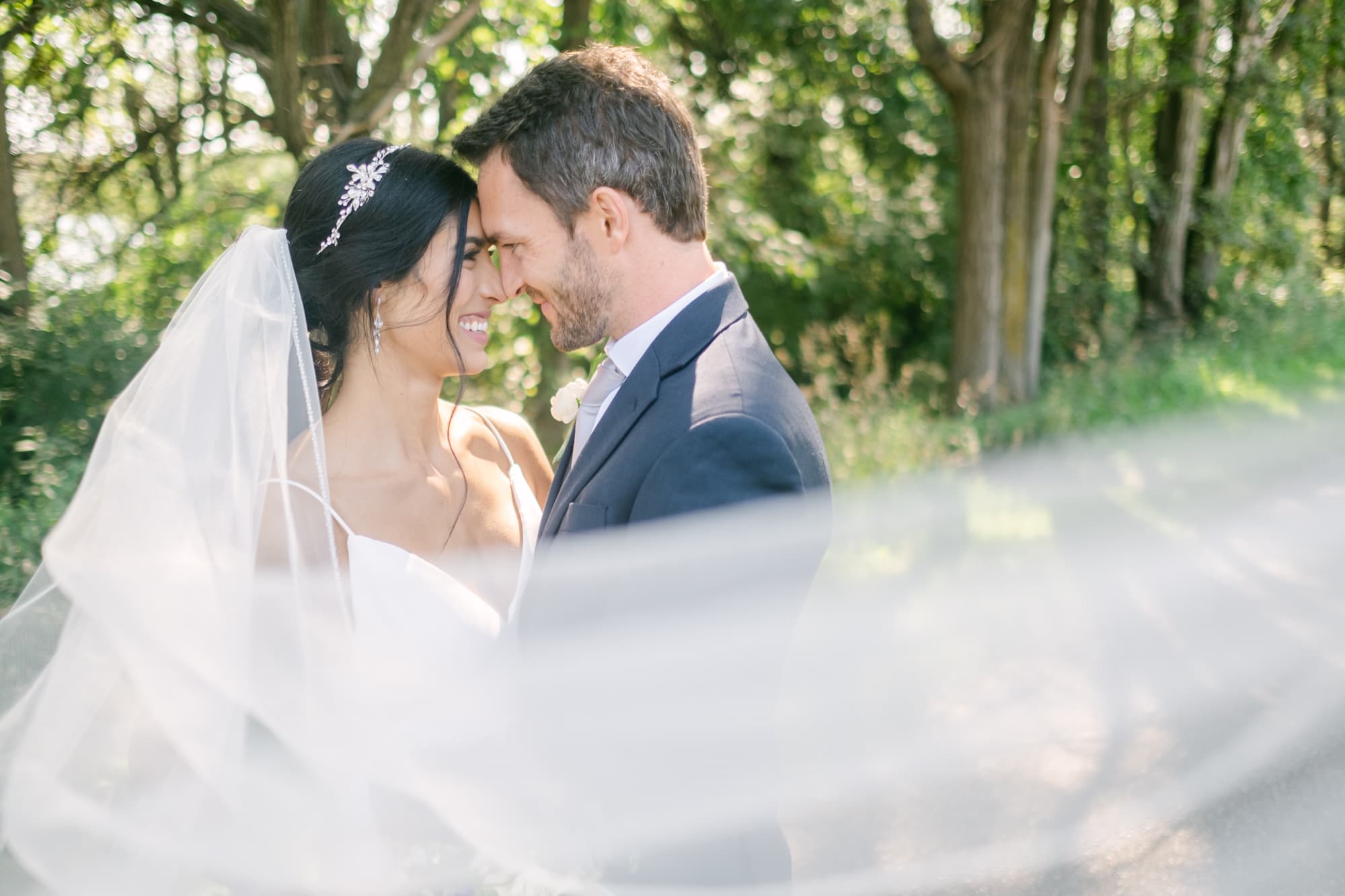
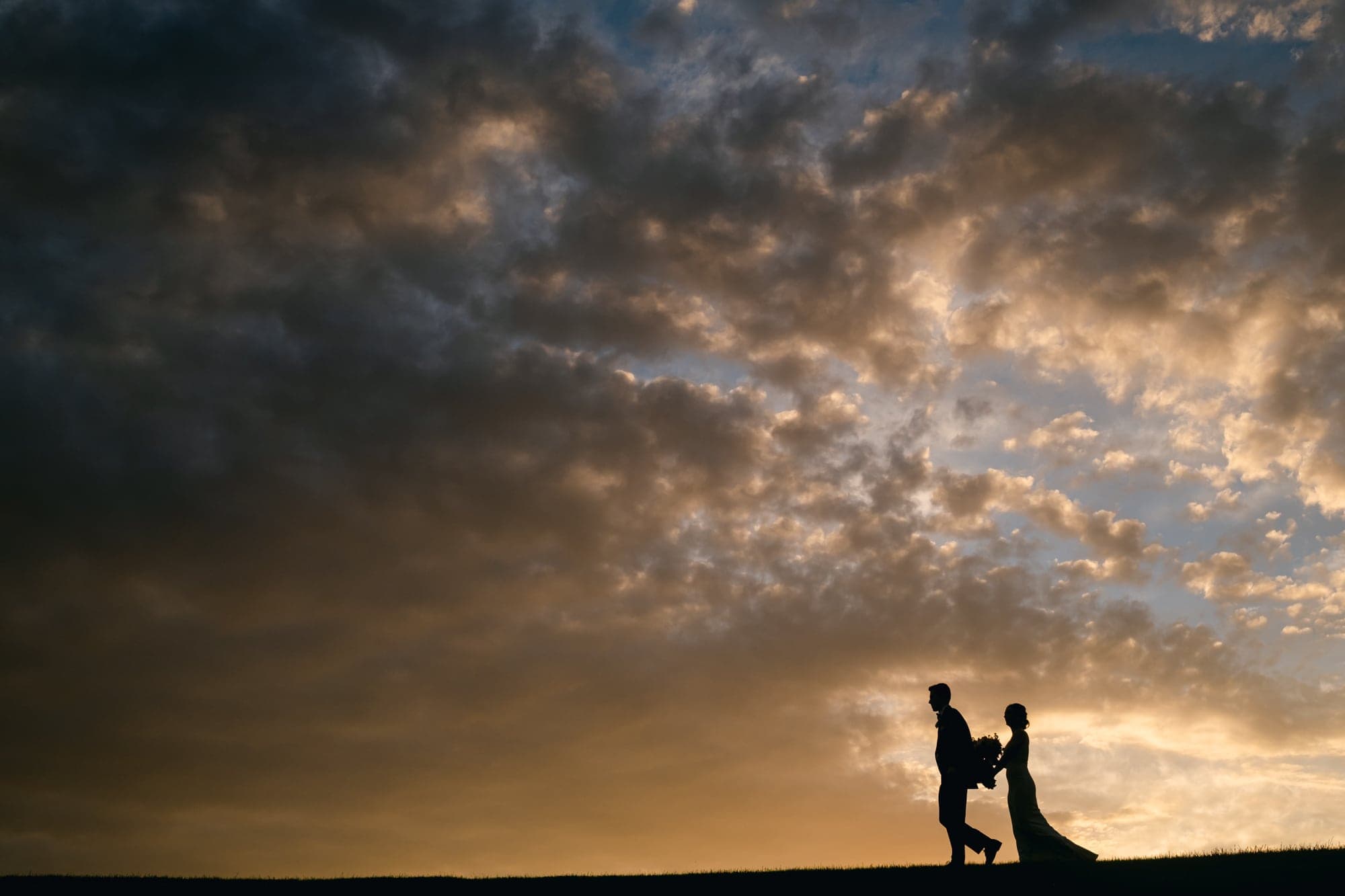
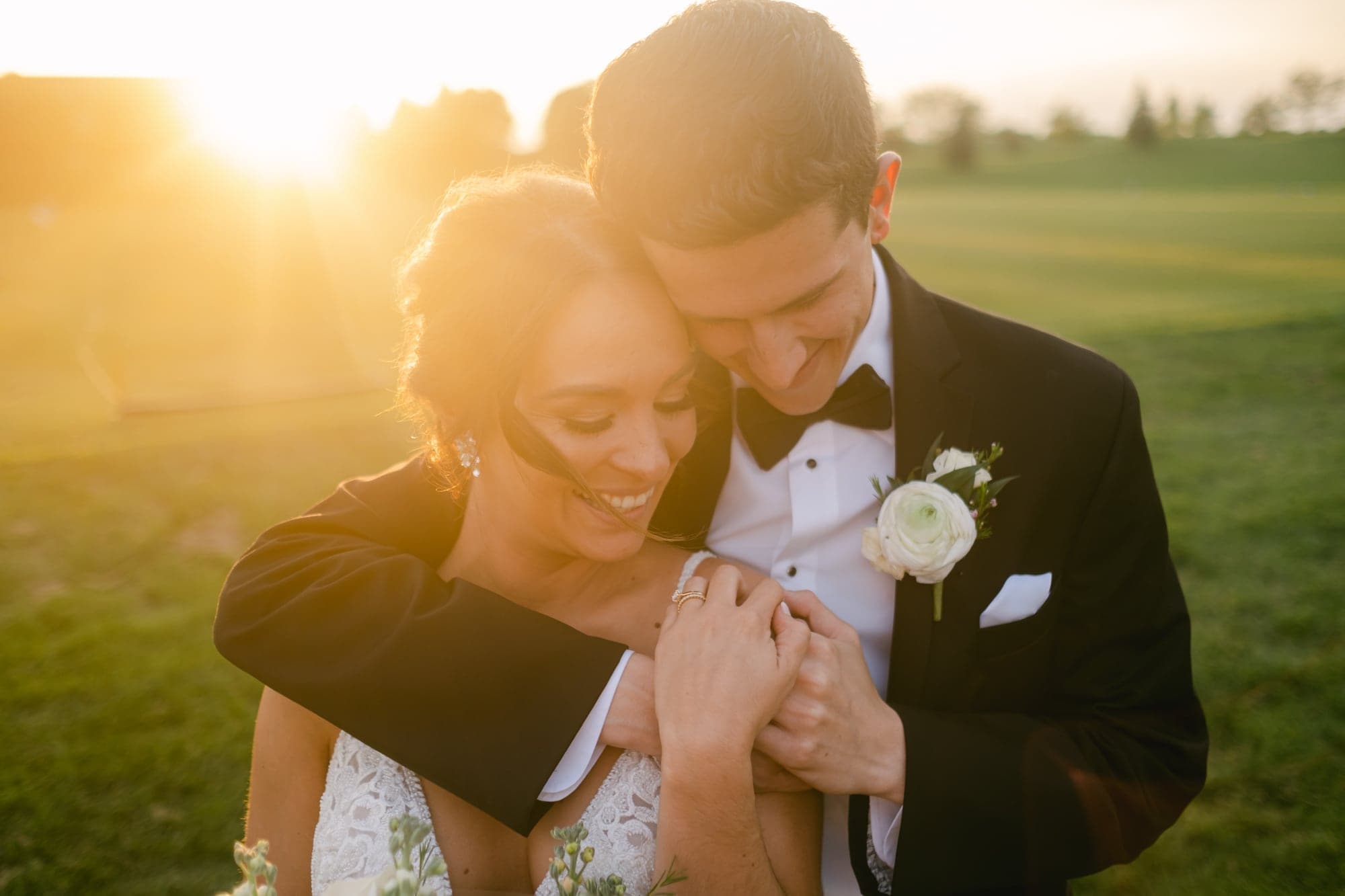
When golden hour actually falls is what decides where this time lands, and it swings a lot by season. Through most of peak wedding season it lands during dinner, which is a natural moment to slip the couple out for ten or fifteen minutes while their guests are eating. In winter it can fall before the ceremony even starts. Look up the real sunset time for the date and venue before you place these, because a 5:00 sunset and an 8:30 sunset build two different days. For the full method on finding and protecting that window, see the golden hour wedding photography guide.
How long do wedding party photos take?
Wedding party portraits take about 30 minutes, though I don't count minutes per group and don't really care about the exact time spent. I try to get through it faster than that on purpose. The same logic runs under a lot of the day. If I finish wedding party photos in 20 minutes, those extra 10 minutes get added to the buffer that the rest of the day can borrow against.
Get the shots you need, keep it moving, and bank the difference. On a well-built timeline, the time you save here is exactly what absorbs the delays you can't control.
How long do family photos take at a wedding?
Family formals run about a minute and a half per grouping, or about half an hour for a normal list. Same as wedding party photos, I don't obsess over the count. Between family formals and wedding party portraits I budget about an hour total, and anything I save becomes buffer.
The real driver here isn't the number of photos, it's attendance. If everyone on the shot list is physically in the room, we can move through combinations fast. But one or two key people wandering off, still in cocktail hour, or not knowing they were on the list, creates far more delay than a long list ever will. The fix is making sure the people on it know they need to be there and when. Build the list by name ahead of time, and have the couple tell their families they're expected before the ceremony, or after if there is no first look. Building that list is a method of its own, how to order the groupings and who belongs in each one, and it has its own complete guide.
How long is a wedding ceremony?
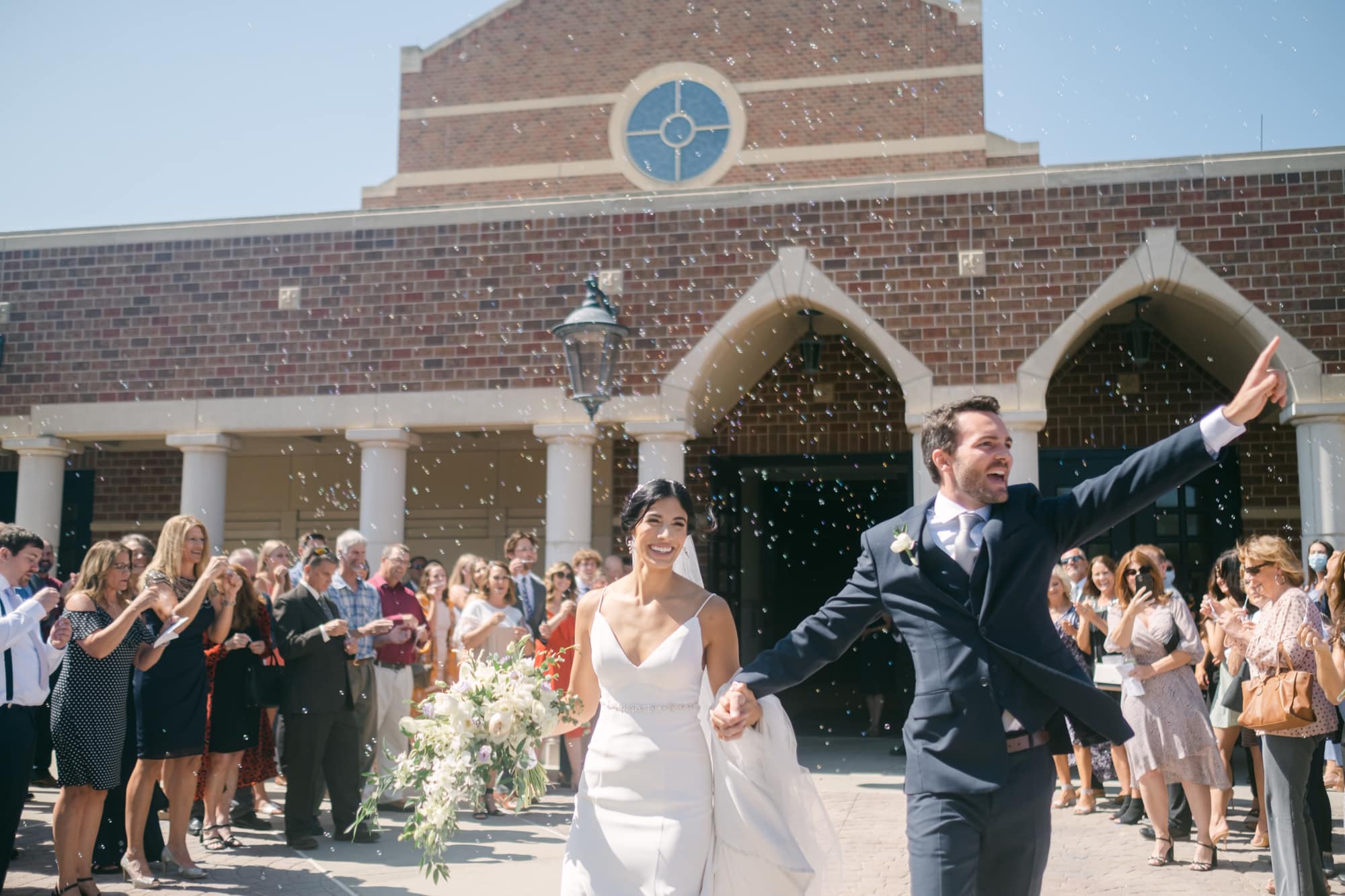
A short secular or civil ceremony runs 15 to 30 minutes. It's usually a processional, a few words from the officiant, vows, rings, sometimes a unity moment, and the kiss. A full religious ceremony is a big variable. Most catholic ceremonies are slated for an hour but are known to run long depending on the homily, so I plan for a full catholic ceremony to run about 15 minutes over, every time. That matters most when there's no first look and all the formals happen afterward, because the overrun eats straight into your post-ceremony window.
An outdoor ceremony runs about as long as the same ceremony indoors. What can add time is logistics, not the ceremony itself: if the ceremony spot is a long walk, a golf-cart ride, or a shuttle from where guests arrive, treat that gap as travel and budget for it separately. And regardless of type, I want all photos wrapped at least 30 minutes before the ceremony starts. Some churches require a full hour, so confirm it ahead of time.
How long is cocktail hour, and what is the photographer actually doing?
Cocktail hour is about 60 minutes, though it's one of the more flexible blocks on the day. There's no rule that it has to be a full hour, and by this point nothing really moves it unless the ceremony ran long.
I'm usually working through most of it. Cocktail hour is when I (or my second shooter) shoot the details of the reception space before guests get into it, knock out family formals if we didn't do them before the ceremony, or slip the couple away for a set of portraits while their guests are occupied. It's some of the most productive time on the whole day precisely because there's no formal event to cover, which frees me up to catch everything happening around the edges.
Reception moments: what needs full coverage and what's just background?
Here's the standard reception sequence and what I budget for each: grand entrance about 5 to 10 minutes, toasts about 10, first dance about 3, parent dances about 5, and the cake cut about 5. Those are the moments that need full coverage, so they anchor the reception. Open dancing is about 30 to 45 minutes of coverage because that's usually where the contracted hours end.
For everything beyond the standard moments, an anniversary dance, a bouquet or garter toss, a sparkler exit, an after-party, I don't put minutes on the timeline. They vary too much with guest count to schedule cleanly, and pinning them to the clock creates the same false precision I avoid everywhere else. Instead I handle them with a coverage end time. I tell the couple when I'll be done, and that anything they want photographed has to happen before then, and I confirm it with the DJ the day of so they pace the night inside that window.
How long does travel between locations really take?
Budget the drive time plus at least 10 minutes, every time. Mapping apps give you a best-case number: one driver, leaving immediately, no friction. A wedding day has none of those. You have to load a group of people into cars, drive slower because you're moving as a pack, and find parking at the other end. That 10-minute pad is the minimum for a normal car-to-car move.
A party bus or shuttle adds more. A bus can take 10 minutes just to unload before anyone is walking anywhere. And once you arrive, budget another 5 to 10 minutes to park, walk, and regroup at the new spot before you're actually shooting. Travel is the block most timelines underestimate, because people plan the drive and forget everything wrapped around it.
When is a buffer optional, and when is it non-negotiable?
There's exactly one buffer I never cut: the 30 minutes before the ceremony. Every photo wrapped at least half an hour before the ceremony starts is what absorbs a late morning. The whole day is anchored to that moment, so that cutoff holds no matter what else has to give.
Everywhere else, I'd rather not label an explicit "buffer" block at all. A block that says "buffer" reads like dead time to a couple, and it invites someone to fill it. Instead I overestimate the real blocks by 15 to 30 minutes each, so the cushion lives inside the day rather than sitting next to it. When one thing runs long, the slack right beside it absorbs the hit instead of passing it down the line. That's more method than reference, so for how to place that cushion across the whole day, see the guide on building a wedding day timeline.
The numbers are starting points, not the day
Every number here is a default, not a rule. They're what I budget after about ten years and a couple hundred weddings, offered as a place to start instead of a blank page. Your weddings will move them, and they should. A photographer who shoots mostly long religious ceremonies carries different defaults than one who shoots mostly backyard ceremonies, and both are right.
When each block on your timeline reflects how long things actually take instead of how long you hope they'll take, the day adds up truthfully, and you find out what fits and what doesn't while there's still time to change it. To turn these durations into an actual timeline, anchored to the ceremony and built backwards, see how to build a wedding day timeline.
I built a tool called Daymarked with these parts of the day built in as blocks, so building a timeline is mostly dropping in the pieces and letting the durations and travel math I've described here fall into place. For my own weddings, the timeline and the formals list went from about an hour of timeline work plus a hand-built list to about half an hour for both, start to sent. The numbers above work exactly the same whether you build your timeline in it, in a document, or on the back of a call sheet.