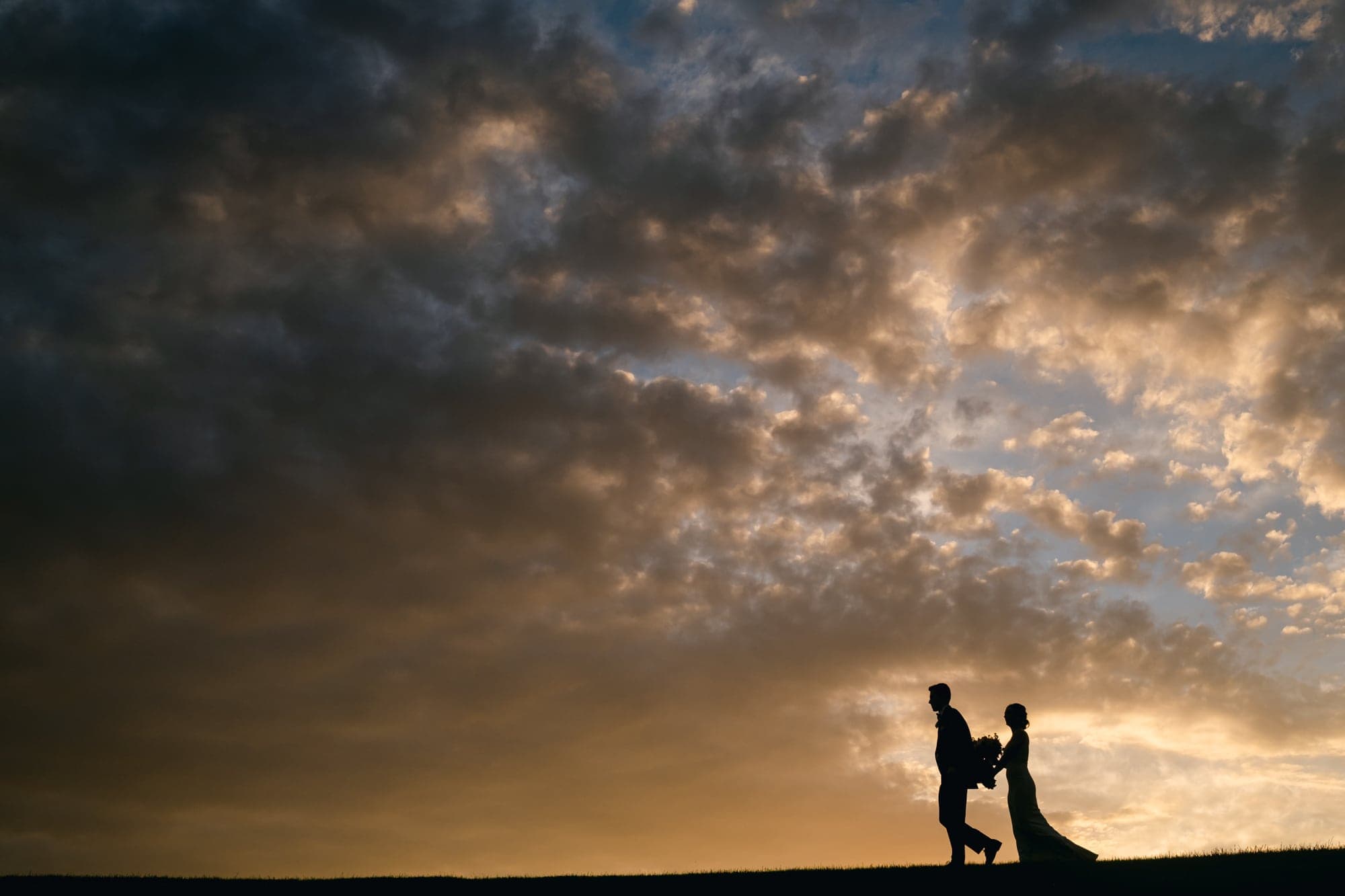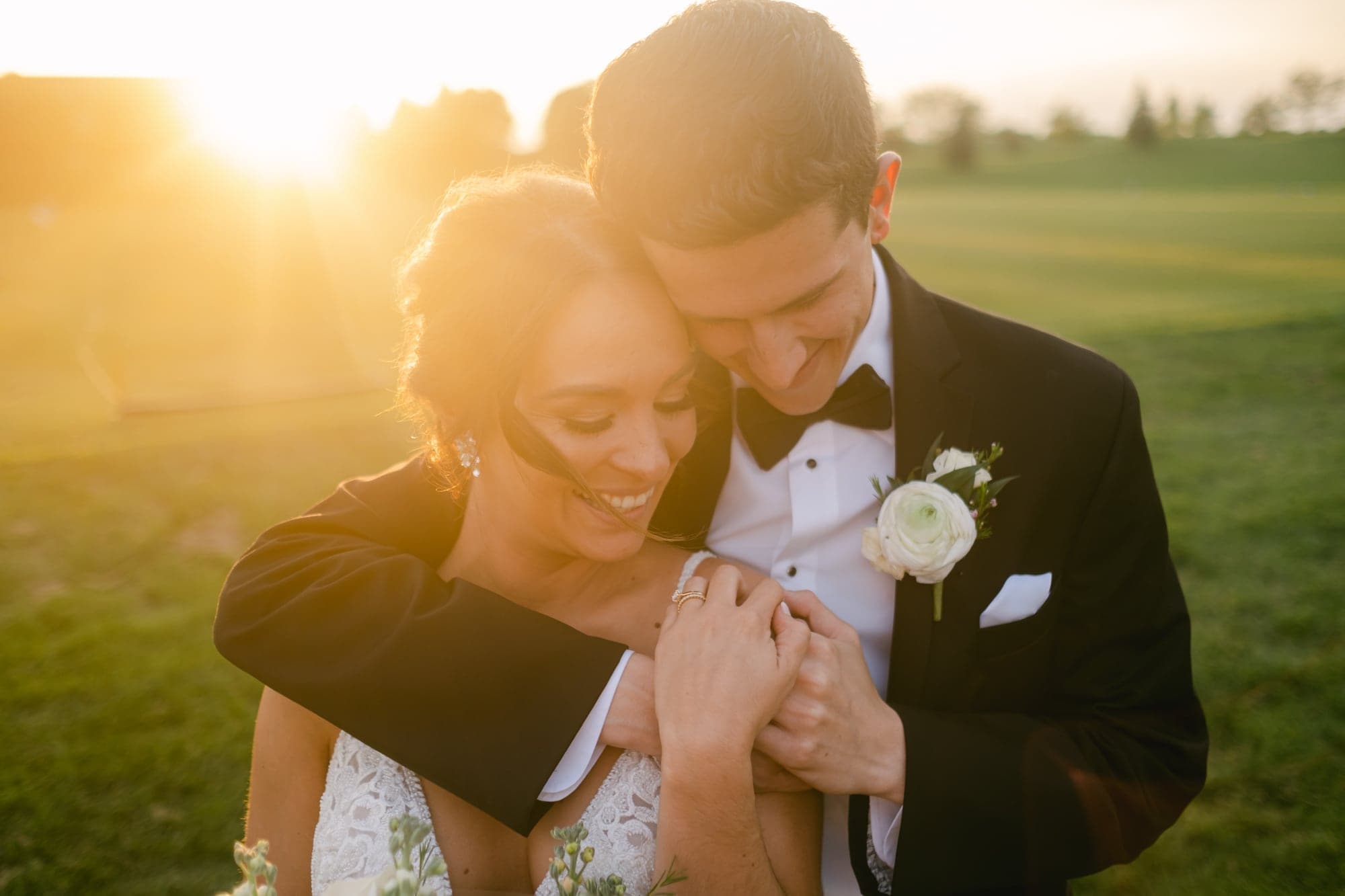
May 22nd at The Club at Indian Creek, Omaha, Nebraska - taken at approximately 8:20 PM, with true sunset at 8:42 PM.
Search "golden hour wedding photography" and you'll get inspiration. Backlit couples, lens flare, Pinterest boards full of warm light. All of it is beautiful but none of it is useful when you're building the timeline that decides whether your couple is standing in that light or watching it slide past the window during toasts.
I've been shooting weddings for ten years, and early on I forgot about golden hour constantly. You plan a June wedding in February, the sun is setting at 5:45 outside your window, and nothing reminds you that on the actual day, the best light won't show up until 8:40 PM.
Sunset is one of the two anchors I build every wedding day around. The other is the ceremony, and the complete guide to building a wedding day timeline covers that side of it. This post is the full method for the light anchor: what golden hour actually is, how far it moves, and how to reverse-engineer the day so that the last portrait session with your couple ends up inside the window.
What is golden hour for wedding photography?
Golden hour in wedding photography is roughly the last 60 minutes before sunset, when the sun sits low enough to throw soft, warm, directional light. It is the most flattering natural light of the day for couple portraits: skin tones warm up, backlight separates the couple from the background, and nobody is squinting. The window is set entirely by the venue's location and the calendar date, and it varies wildly throughout the year.
Why does golden hour change so much by location and season?
Golden hour moves with location, season, and daylight saving. A late-June wedding in Minneapolis has sunset just after 9:00 PM, which puts golden hour at roughly 8:00 to 9:00 PM, after dinner and well into dancing. A mid-November wedding in Houston has sunset around 5:30 PM, which puts golden hour at roughly 4:30 to 5:30 PM, overlapping a late-afternoon ceremony. That is more than a three hour difference on the clock for the same phrase. Daylight saving compounds it: when clocks fall back on the first Sunday of November, sunset lands an hour earlier overnight. The practical rule is that you look up sunset times fresh for every booking instead of assuming it looks like your last one.
Those two windows build two completely different days. The June day in Minneapolis has the whole reception in daylight, and sunset portraits mean stepping off the dance floor at 8:30. The November day in Houston is dark before dinner is served, so any sunset portraits have to happen right around the ceremony itself, which quietly turns it into a first-look conversation.
This is exactly why planning months ahead goes wrong. The date and the venue already decided the window, the only question is whether your timeline knows it.
How do I find the sunset time for my venue and wedding date?
Look up sunset for the venue's town on the actual wedding date. Any weather app or sunset lookup site will give it to you and that number is the anchor everything in the next section hangs on. Then subtract one hour and write both times down on your timeline.
When you're building a timeline in the off-season, nothing in your environment hints that the date you're planning lives in a different light. I skipped this step more than once early on, anchored a day to the ceremony alone, and only realized on the wedding day that the light I wanted had been scheduled away months earlier. Now it's the second thing I check on every booking, right after the ceremony time, and I check it again when I actually build the timeline in case anything about the venue or date shifted.
How do I plan the day so couple portraits land in golden hour?
To land couple portraits in golden hour, plan the day backwards from sunset. Look up the real sunset time for the venue and the wedding date, subtract one hour, and mark that window on the timeline. Aim the actual session at the back half of the window; the last 30 minutes before sunset is the best light, and a cloudier forecast pulls it earlier. Then find the least disruptive slot in the reception that overlaps the window, usually dinner service or open dancing, and drop a 15-to-20-minute portrait block there. Finally, protect it upstream: confirm the couple is free at that time, confirm the grand entrance is scheduled to happen well before the window opens, and bank a solid set of portraits earlier in the day so the plan survives weather. The sun does not flex, so everything else has to.
Here's each step:
- Look up the real sunset time for the venue and the date. Not "around 8," the actual number.
- Subtract an hour and mark the window. That band is now a fixed object on your timeline, exactly like the ceremony.
- Aim for the last 30 minutes before sunset. The window is an hour wide, but the session doesn't need to start at the top of it because the best light is at the end. If the forecast shows clouds building, shoot earlier in the window.
- Pick the exit, not just the time. Scan the reception plan for the slot where a 15-to-20-minute absence costs nothing. Through most of peak season golden hour lands during dinner service, which is the natural opening: guests are eating, nothing is being missed, and the couple gets a quiet break from hosting. Later sunsets land during open dancing, which works just as well.
- Check it against your coverage end. A 9:00 PM sunset with coverage ending at 8:00 is a conversation to have at booking, not the day of.
- Check what has to be true upstream. Is the couple actually free then, or is that the cake cut? If the portrait spot is off the property, travel is a real consideration. Bank a solid portrait set earlier in the day regardless, so weather can't zero you out. (Couple portraits run 30 to 45 minutes total across a whole day, spread across first look, post-ceremony, and sunset. The wedding day timing guide has the full numbers.)
That's the entire method. It's the same build-backwards discipline as the ceremony.
What has to move to protect the golden-hour window?
The part of the schedule that decides whether golden-hour portraits happen is the grand entrance. Once the couple enters the reception, the evening runs as a chain: dinner, toasts, dances, open floor. If the entrance is late, everything downstream gets pushed back. The most common cause of a late entrance is a party bus during cocktail hour: load and unload time multiplies with every stop, so a couple who planned three or four photo stops comes back well behind schedule. Ask for the bus stops in advance and advise limiting them to one or two. The stakes depend on the season: with a 6:00-to-7:00 PM golden hour, a late entrance kills the window, while an 8:30 PM summer sunset is pretty forgivable.
How do I explain the golden-hour plan to a couple?
Put sunset portraits on the timeline as their own block, then say it out loud at the final walkthrough. I do a Zoom call with every couple the week of the wedding, and golden hour gets explicitly called out: when we'll step out, roughly how long, and the honest caveat that it may or may not happen depending on the sky. Setting it up as conditional does two things. Nobody is disappointed if clouds eat the window, and the couple understands why I care about the entrance happening on time.
How much selling it needs depends on where it lands. When the session falls during dinner service, it barely needs a mention, because nothing has happened yet for the couple to miss. When it's a summer wedding and the window opens at 8:00 PM, mid-party, I frame it the way I actually see it: sunset photos are a great way to put a bow on your photography coverage with some of the best shots of the day, and it gives you a break from the loud dancing to really soak in the entire day. Fifteen minutes, a short walk, and back before anyone finishes a drink. These end up being their favorite images, and most of them already know it.
What do I do on an overcast day or when the day runs behind?
Overcast: a bright overcast day is not a loss. The light goes soft and even, portraits are forgiving, and you're freed from chasing an exact minute. Shoot earlier in the golden hour window, because whatever glow exists will die before the clock says sunset. A fully grey sky is a different call. If the cloud cover is total and the venue doesn't have a location that earns the walk, I cut the session entirely. That call is only easy because of step six above: there's already a strong portrait set banked from earlier in the day, so a sunset session with no sunset adds nothing.
Behind schedule: I fight for the window at almost every wedding, because the session compresses better than any other block on the day. The full version is twenty minutes; the collapsed version is five to ten, and it still delivers. The collapsed version works like this: know your spot before you need it (if I know the venue, I have one in mind before dinner starts), keep it to one or two locations close by, and get variety from working different looks in each spot instead of walking to more spots.
Should you leave the reception for golden hour portraits?
When golden hour lands during dinner service, there is no trade-off: the couple slips out while guests eat, and the reception never notices. The conflict comes when sunset overlaps toasts, the first dance, or the ceremony itself. My default is to fight for the sunset session anyway, because it can shrink to five or ten minutes and still deliver, and those frames are usually the couple's favorite set of the whole gallery. I cut it in three situations: the couple is completely worn out, the weather has taken the light, or the venue has no spot worth walking to. If the venue has no sunset potential, spend cocktail hour somewhere beautiful and bank everything early. If it does, schedule the evening so stepping out costs ten minutes, not a first dance.
The best example I have of making the trade early: a couple whose reception venue had no good sunset locations at all. No field, no treeline, no west-facing anything. Instead of pretending, we planned around it. They chose to spend their entire cocktail hour at a beautiful spot nearby and we banked every portrait they wanted while the light was still good. Sunset came and went during the reception and nobody chased it, because the decision had been made months earlier with the venue's geography on the table.
Two more things to consider. Whether there's a first look changes how much is riding on sunset, since a first-look day banks a full portrait set before the ceremony and turns golden hour into a bonus; that fork is worth a guide of its own. And in midsummer, protecting an 8:30 PM window can mean coverage runs later than the couple originally booked, which is a coverage conversation.
The day is built around two fixed points
So: look up the real sunset for the venue and the date, subtract an hour, and mark the window before you place anything else. Aim the session at the last 30 minutes of light. Give it the least disruptive exit the evening offers. Watch the grand entrance, ask about the party bus, and bank a set earlier in the day so weather never gets a veto over the gallery. Do that, and golden hour becomes something your timeline was built for.
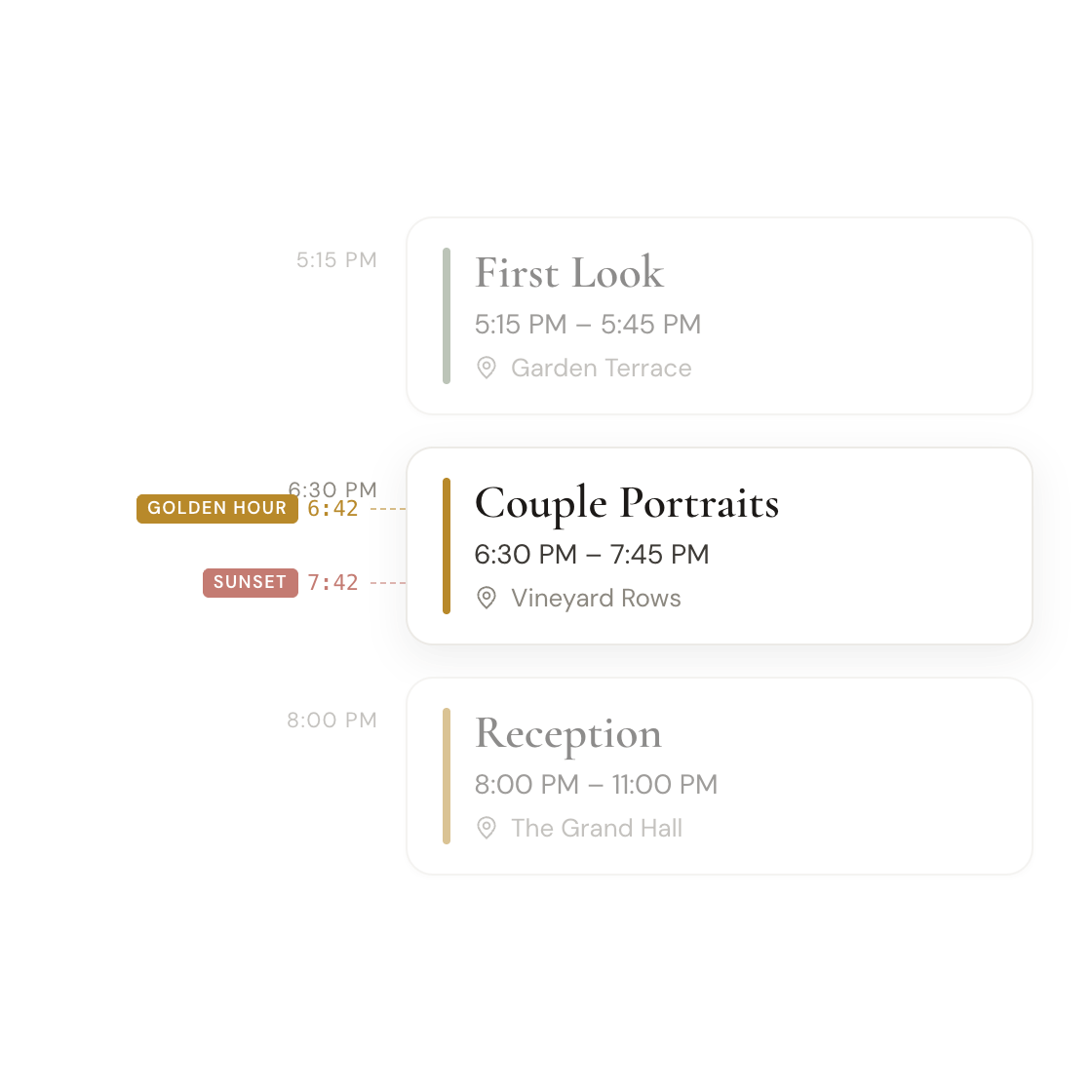
One footnote, since this is the tool I ended up building: Daymarked draws the sunset marker and the golden-hour band on every timeline for you, worked out from the venue's location and the wedding date, and it flags real travel time between locations while you plan. The method above is still the method. The tool just does the lookup-and-subtract on every wedding, so you never again plan a June day with February light in your head.