You send the questionnaire, and two weeks later the answers come back.
Getting ready: "my mom's house." Ceremony: "St. Mary's." Start time: "around 4."
Technically the couple answered every question but you can't build a timeline out of any of it, and now you're chasing the same details a second time over email. In my experience, vague answers come from the question itself, not the couple.
This guide is my actual questionnaire after ten years and a couple hundred weddings: every question I ask, the format I collect each answer in, and the questions I only added after a day went sideways without them. It's the companion to my full timeline guide, and the two depend on each other. The timeline can only stay broad and relaxed because the details underneath it are exact, and this is where those details get locked down.
Why open-ended questionnaire questions get vague answers
Early on I took whatever a couple gave me. "St. Mary's" went straight into my notes, and I found out on the wedding day that there are three St. Mary's in the area when I drove to the wrong one. To my couple, "St. Mary's" is a complete answer. The question never told them I needed anything more.
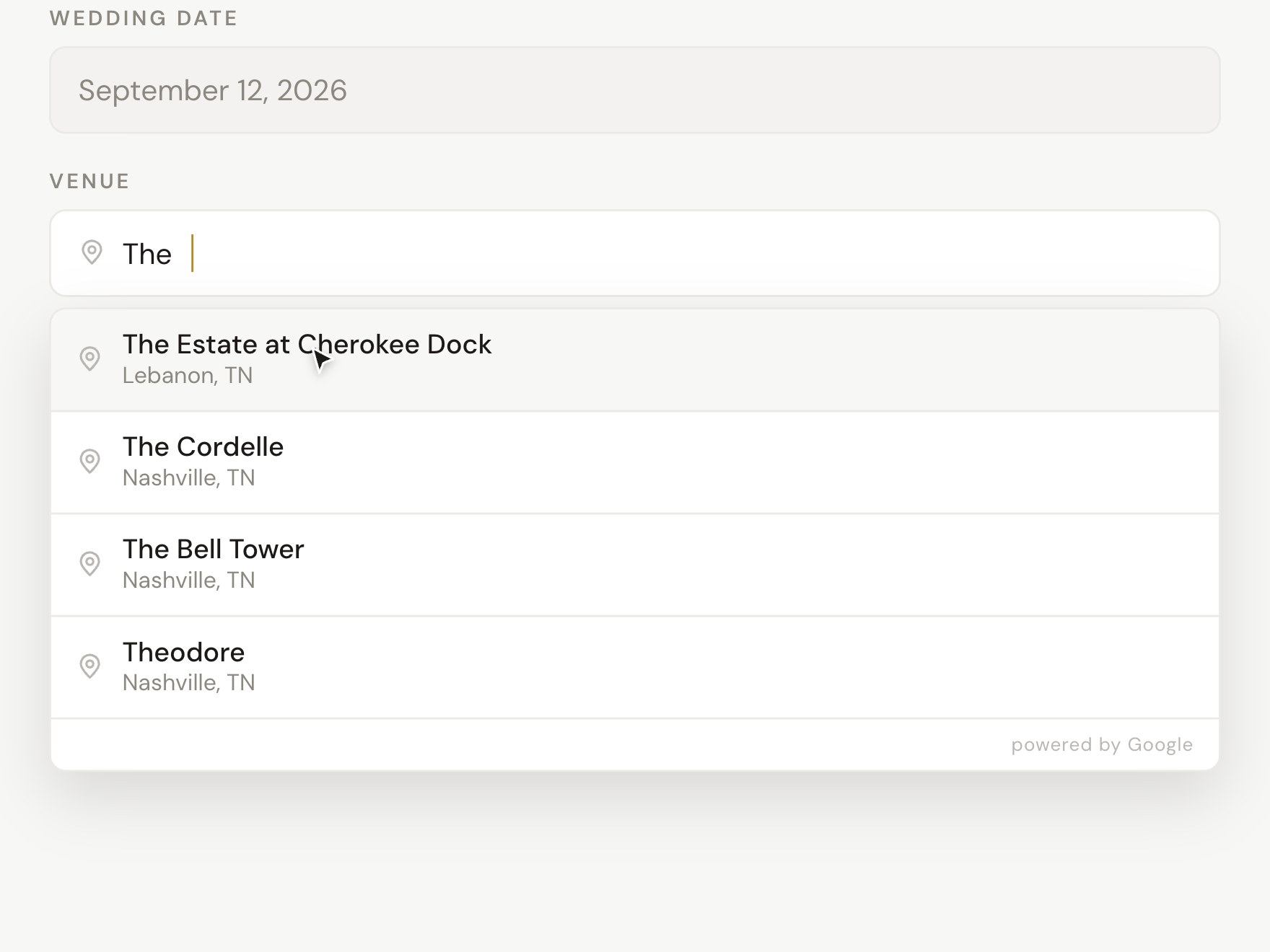
Instead, ask the same couple for a full street address in a field that expects one, and "my mom's house" becomes almost impossible to type. The same goes for times: "When is the ceremony?" gets "around 4," while a time field gets 4:00 or 4:30. Every question on a wedding photography questionnaire should be collected in the most specific format the answer allows: an address field for locations, a time field for times, a yes/no for decisions, full names and relationships for people.
Here's the same information asked both ways:
| How you ask | What comes back |
|---|---|
| "Where are you getting ready?" (open text) | "My mom's house" |
| "Where will the bride & bridesmaids be getting ready?" (an address field: street, city, state) | A real street address you can put in your phone |
| "When's the ceremony?" (open text) | "Around 4" |
| "When does the ceremony start?" (a time field) | 4:00 PM |
What should a wedding photography questionnaire include?
A wedding photographer's questionnaire needs to collect six kinds of information:
Contacts: The couple, the maid of honor and best man, and both sets of parents, with names spelled out and phone numbers you can call on the day.
Locations: The full street address for the ceremony, the reception, and each getting-ready location.
Times: Exact start and end times for the ceremony and reception, and when getting ready starts for each side.
Structural decisions: A yes/no on the first look, and a yes/no on whether the groom's side wants getting-ready photos at all.
People lists: Every wedding party member by full name, and every family member for formals by full name and relationship.
Events: What happens right after the ceremony, and which reception moments are happening.
Below is my questionnaire, question by question, in the order I ask it. One note before the list: my questions say bride and groom because that's who I'm usually shooting. Swap the labels for the couple in front of you; the structure doesn't change.
Main contacts
- Bride's first and last name (text) and groom's first and last name (text)
- Bride's phone number (phone) and groom's phone number (phone)
- Maid of honor's name (text) and phone (phone)
- Best man's name (text) and phone (phone)
- Mother and father of the bride (text), with this instruction under the field: "Please indicate which name is which and if there are any step parents (Example: Kerry Andersen, Mother; Bob Jones, Father; Mike Andersen, Step-Father)"
- Mother and father of the groom (text), same instruction
The maid of honor and best man phone numbers exist because on the wedding day you don't call the couple, you call the people standing next to them. The parent questions carry that example text because "my parents are Kerry and Bob" doesn't tell you which is which when you're lining up formals, and step-parents you didn't know about are one of the most common day-of surprises.
Locations and times
- Ceremony venue name and full address (an address field: street, city, state, zip)
- When does the ceremony start? (time) and when does the ceremony end? (time)
- Reception venue name and full address (address field)
- What time does the reception start? (time) and end? (time)
- What time do the wedding party and couple need to be at the reception? (time)
- Will you have a first look? (yes/no)
- Where will the bride and bridesmaids be getting ready? (address field) and what time? (time)
- Will the groom and groomsmen simply show up dressed and ready for the ceremony, therefore NOT having getting-ready photos taken? (yes/no)
- If no: where will the groom and groomsmen be getting ready? (address field) and what time? (time)
I ask for the ceremony's start and end time instead of asking what type of ceremony it is. By the time the questionnaire goes out, I don't care whether it's a full Catholic mass or a ten-minute backyard ceremony. The start and end pair tells me everything the timeline needs.
"Reception start" is a venue fact, not a timeline fact. If the ceremony ends at 4:30 at the same venue as the reception, the reception technically starts at 4:30, but the couple might not need to walk in until 5:30. That gap between "reception starts" and "couple needs to be there" is where your formals, portraits, and travel actually live, so I ask for the arrival time directly.
And notice the first look question doesn't ask for a location. Picking the first look spot is a decision I make as the professional, usually by scouting during getting ready, unless the couple feels strongly about a location. The yes/no itself is the biggest structural answer on the whole form; for what each answer does to the shape of the day, see the first look vs. no first look guide.
The wedding party
Header on this section, verbatim: "Please include full names!"
- Who are all of the bridesmaids? One name per line (long text)
- If applicable, who are the personal attendants? One name per line (long text)
- Who are all of the groomsmen? One name per line (long text)
- If applicable, who are the ushers? One name per line (long text)
"One name per line" sounds fussy until you've untangled a paragraph of first names separated by commas, some of them nicknames. Full names, one per line, becomes a checklist you can actually run.
Family formals
Header on this section, also verbatim: "When providing answers to this section, PLEASE include full names & relationships of everyone you entered. Please include members of the wedding party who are also family!"
- The names AND relationships of all family members on the bride's side who will be present for family photos, one per line (long text)
- The names AND relationships of all family members on the groom's side who will be present for family photos, one per line (long text)
- During your family formals, are there any people not part of the family or the wedding party that you would like a photo with? (long text)
I never ask the couple to write the photo groupings. Instead I collect full names and relationships and build the shot list myself from standard combinations: couple with her parents, couple with his grandparents, and so on. Then the couple reviews the list and adds or removes groups. On the wedding day I'm calling out "Kerry and Bob, you're up," not pointing at strangers and hoping. That build-it-myself step is a whole method of its own: the grouping ladder, the honest timing, the divorced-parents and step-family structure, and a printable template, all in the complete family formals shot list guide.
The "anyone not family or wedding party" question earns its spot too. Godparents, a best friend who flew in from overseas, the officiant who married their parents. Nobody volunteers these until you ask.
Where the groupings list lives, and what the couple sees versus what you carry, is its own topic, worth a guide of its own.
Post-ceremony
- After your ceremony concludes, what will happen? A receiving line? A bubble exit? Be as specific as you would like. (long text)
- Will you have a party bus? (yes/no)
- If yes: where will the bus go, and for how long? (long text)
- Is there anything special you would like to do after the ceremony before we head to the reception? (long text)
This whole section exists because of days that went sideways. More on that below.
Reception events
- During your reception, what will be taking place? Check all that apply: announcement of the wedding party and couple, cake cutting, toasts, first dances, bouquet toss, garter toss, dollar dance (checkboxes)
- Anything other than what was listed above? (long text)
Notice there are no time questions here. No "what time is the cake cutting," no speech order. That's deliberate, and it goes back to the broad-not-precise idea from the timeline guide: by the time the reception arrives, my timing job is basically done. I need to know what is happening so nothing gets missed and everything the couple cares about lands inside the coverage window, and I need to coordinate with the DJ so I can slip out for sunset photos. Beyond that, I have no interest in the exact minute dinner is served. I'll adapt to what actually happens.
The catch-all closers
- Are there any special details unique to your wedding day that you would like special attention given to? (long text)
- Is there anything not covered in this questionnaire that you would like added to your timeline? (long text)
Once all of the important details have been locked down, these last two fields serve as a catchall for anything that we may have missed throughout. Often times these answers are empty but the few times that I've gotten key information back makes them worth keeping.
How to ask for coverage start and end times
Coverage start and end times should not be questions on a wedding photography questionnaire. Couples don't know when a photographer needs to arrive; asking them just collects a guess you'll have to correct later. Instead, collect the facts the math depends on: the ceremony start and end, the reception start and end, where and when each side is getting ready, and whether there's a first look. Combine those with the hours on the contract and the coverage window calculates itself: stack the pre-ceremony blocks backwards from the ceremony to find the start, then build forward through the reception until the booked hours run out. If the couple's plans don't fit inside their contracted hours, that surfaces months before the wedding, while there's still time to add hours or adjust the plan, instead of at the end of the night.
The full method is in the timeline guide, but the point for the questionnaire is: ask for facts, not conclusions.
The questions you only learn to add after getting burned
Every template covers names, locations, and times. The questions in this section are the ones I added one at a time, each after a wedding day taught me to. The pattern behind all of them: couples won't tell you things unless you ask directly. Not because they're hiding anything, but because they don't know what changes your day. To them, a receiving line is a nice moment with their guests. To you, it's a schedule event.
The groom qualifier. I used to just ask where the groom was getting ready, and I'd get a perfectly good answer. What nobody mentioned was whether they even wanted getting-ready photos of the groom. So I'd plan the whole morning's routing around a second location, for a set of photos the couple never cared about. Now a yes/no comes first: will the groom and groomsmen simply show up dressed and ready? That one question is a qualifier for how the entire morning gets structured.
What happens right after the ceremony. This one was the biggest unlock of any question I've added. I kept getting surprised by receiving lines: the ceremony ends, and instead of moving to formals or travel, the couple spends a chunk of time greeting every guest, cutting straight into the travel and portrait time we'd planned. Now I ask exactly what will happen after the ceremony, and I ask the couple to be as specific as they want.
The party bus. A party bus changes how the whole middle of the day runs, and not everyone will mention it beforehand because it's just transportation, but for me it's very concrete: if I drove myself to the ceremony and then ride the bus with the wedding party, how do I get back to my car? Where is the bus going, and for how long? I need to know that in advance, not in the parking lot after the ceremony.
Ushers and personal attendants. They're sometimes treated like full wedding party members, and sometimes they're not, and you can't tell from the outside. I've had a groom who wanted photos with his two ushers, but because they technically weren't groomsmen, they never made the photo list, and we found out on the day. Now both get asked about explicitly, every time.
None of these questions are clever. Each one is a day that went sideways, converted into a field. That's really what a good questionnaire is: your mistakes, written down as questions so you only make each one once.
What to do when an answer comes back vague
Even a well-built questionnaire leaks a little. Somebody types the venue name into the notes field, or the family list comes back with "and cousins" at the end of it. What matters is what you do between that answer and the timeline.
When a questionnaire answer comes back vague, don't quietly build the timeline around the gap and hope it resolves. Build the first draft anyway, flag every soft answer directly on it, and send it with a specific ask: not "can you confirm the details" but "I need the street address for your mom's house" or "which cousins, by name, should be in the family photos." If the couple doesn't respond, raise each flagged item on the final walkthrough call about a week before the wedding, which is the last natural moment details change. The one section that stays soft the longest is the family photo list, because it depends on other people's attendance, and that's normal: expect names to shift up to about a week out.
The follow-up is also where changes are most likely to get lost, because a correction that arrives by email has to actually make it into the timeline, not just into your inbox. I learned that one personally: a family-photo change came in late, I wrote it into the document on my laptop, and on the wedding day the version in my hand didn't have it. Wherever your timeline lives, the rule is the same: a change isn't handled until it's in the version you'll be holding on the day.
When should you send the wedding photography questionnaire?
I send the wedding photography questionnaire about three months before the wedding. It's close enough to the day that most of it is actually decided, far enough out that there's still room to work through changes. I let the couple fill the questionnaire in at their own pace rather than demanding one sitting; answers can arrive over weeks and that's fine. Two things won't be final even then: the family photo list keeps shifting, and small additions surface on the final walkthrough call. When the couple walks the day step by step they'll remember what they left out.
Two other timing notes from experience. First, you usually know the ceremony venue at booking, months before the questionnaire goes out. In the worst case, where a couple never finishes the questionnaire, that one fact plus the contract hours is enough to rough out a defensible timeline. Second, expect additions. A morning that started as bride-prep-only sometimes grows a groom side later, and the morning gets reworked to fit it. The questionnaire is the foundation, not the final word. The final check happens in the last week, when you confirm what the couple originally told you against what's now true.
The questionnaire is why the timeline works
My timeline philosophy is to keep the day broad and flexible, with generous blocks that absorb delays instead of amplifying them. People sometimes hear that as being relaxed about details but it's really the opposite. The only reason the timeline can afford to be loose is that every fact underneath it is exact: a real address for every location, a real start and end time, every name spelled out with a relationship attached.
So steal this questionnaire. Take the field list above, rebuild your own intake around it, and be ruthless about formats: addresses as addresses, times as times, decisions as a yes/no. You'll still get the occasional soft answer, and now you'll know what to do with it.
And if you'd rather not rebuild it yourself: this questionnaire is built into Daymarked, the timeline tool I made. The questions are structured fields, so a location question can't come back as "my mom's house." Your couple opens a link and fills it in, no account, no login. And their answers land on the same wedding the timeline is built from, so the details and the timeline never drift apart. The same answers also generate the family formals shot list, with its own share link and a PDF you can print for the day. It's the same method either way. I just got tired of enforcing it by hand.